
CBS News Reports, the holiday season might not be so jolly for shoppers returning presents. Some major retailers are cracking down on repeat returns and changing their policies, too.
Retailers say fraud involving returns costs stores $16 billion dollars a year, so more and more chains are fighting back with policies and practices that make it tougher to return things.
They're shortening the time you have to return items after they're bought, hitting customers with hefty "restocking fees" on returned items, and cracking down on "serial returners" with new, sophisticated computer tracking equipment.
.
.
.
This fall, Sears began imposing a restocking fee of 15 percent of the purchase price on all electronics products that are returned after they've been used, or with missing parts or manuals. And while they give you 90 days to return other products, you now have only 30 days to return electronics items.
.
.
.
Many major retailers are even using hi-tech computer systems that track every return you make, and put a red flag on serial returners.
For instance, Wal-Mart has a system that automatically flags customers who try to return more than 3 items without receipts in a 45 day period. If you surpass that limit, they won't accept your returns. If you don't make any returns without a receipt within a six month period, the red flag goes away.
Check out the roundup on the Indian Retail Industry from the recently concluded India Economic Summit 2005. There are interesting observations and concerns on FDI in retail sector from the who's who of the Indian retail industry.
Co-Chair Sanjiv Goenka, Vice-Chairman, RPG Enterprises, India, said that retailing accounts for approximately 10% of India’s GDP and employs more people than any other industry. The challenges for achieving critical mass and generating employment in the retail industry relate to the integration of small and large retail, the integration of rural and urban markets and the integration of supply chains for a unified market. The issue is foreign direct investment (FDI) in retail; there are concerns that it will create monopolies. Demand impetus should be created through a single market and uniform taxes.
Kishore Biyani, Managing Director, Pantaloon, India, said that FDI has to enter the retail sector sooner or later. India is the last leg of the large consumer base and retail is the last leg of any business value chain. However, he stated that FDI in retail should be delayed. India is giving away a Rs 300 billion market for US$ 1 billon of FDI.
B. S. Nagesh, Managing Director and Chief Executive Officer, Shoppers Stop, India, felt the issue of foreign retailers is being confused with FDI. If foreign brands are allowed to manufacture in India, they should also be allowed to retail. The consumer has to be given a choice of goods.
Hans-Joachim Koerber, Chief Executive Officer, Metro, Germany, a Co-Chair of the India Economic Summit 2005, said investments are needed in the supply chain. Almost all developing countries have allowed FDI in retail in a controlled way. Retailing is a technology-based business. India can wait until Indian retailers wake up or allow the nation’s retailers to benefit from the experience of other countries. A foreign retailer that has local staff does business in a country, for a country, he emphasized.
Suhel Seth, Chief Executive Officer, Equus Red Cell, India, said FDI is not about patriotism but about serious consumer issues. Indian retailers are waiting for better value. If retail prices go down, consumer spending will be spurred, and it is then irrelevant where the money comes from. From a marketing perspective, retail will give consumers more choice and allow local brands to develop.
Jean-Paul Thill, Chief Executive Officer, EMA Region, KPMG, France, said it does not matter where FDI comes from. India’s modernization is inevitable. It has a very vibrant IT sector, while it trails in retail. A mix of investment in cold storage and supply chains is needed.
Samir Modi, Managing Director, Modi Enterprises, India, said the concern is whether India wants organized retail or not. Taxes are too high and too many authorizations are required. Making organized retail easy is what is needed today. Multinational corporations offer margins of 9-11%, which is considered absurd in international markets. Levelling the playing field for the organized and unorganized markets will resolve the FDI question.
Abhiram Seth, Executive Director, Exports and External Affairs, PepsiCo India Holdings, India, said there is no incentive for quality products, especially for farmers. The impact of pricing on farm incomes is high. A 50-paise difference per kilogramme makes a difference of Rs 10,000 per acre of crop for the farmer. An aggregated model to provide better returns to the farmer and better value to the consumer is necessary.
Ajay Dua, Secretary, Department of Industrial Policy and Promotion, Ministry of Commerce and Industry, India, said the issue in retail is not limited to FDI. Retail in India represents 11% of the GDP, with a market size of Rs 300 billion, a much larger percentage than in most countries. India has a national policy on manufacturing, agriculture and tourism. Therefore, a national policy on marketing is now needed. There are, however, numerous alternatives with considerable differentiation – wholesale vs retail, rural vs urban, lifestyle goods vs basic goods, etc. Within these lies the issue of organized vs unorganized marketing. Organized marketing has not eliminated unorganized marketing anywhere in the world; the two have to coexist. Organized marketing in India is growing at 18-20% and has given a boost to real estate. It has, however, not helped rural marketing, supply chains, consumption and purchases by tourists. Malls have not started selling ethnic goods either. Some employment has probably been generated. A macro perspective on marketing is needed. Making a policy based on conjecture would lead to improvisation.
A newly published study finds that apparel and footwear retailers can expect a quick and significant return on investment from deploying RFID at the item level.
RFID Journal
Convenience Store News reports:
Pay By Touch and NCR Corp. are combining their hardware and software solutions to offer retailers a single point of contact for supporting their entire merchant and consumer biometric needs.
"Consumer demands for convenience are growing at an unprecedented pace, and retailers of all sizes need a fast, simple and secure solution that provides the ultimate customer service," said Stephen Reade, senior vice president of product of Pay By Touch. "Our alliance with NCR addresses these needs with a fully integrated solution that improves the checkout experience -- and merchants’ top and bottom lines -- while also positioning our services for expansion into other vertical markets."
Using NCR’s biometric-enabled point-of-sale solutions, retailers can use the Pay By Touch authentication and payment service, providing shoppers a convenient and secure way to pay for goods with the touch of a finger.
[via NRF SmartBrief]
Google's Froogle service offers the promise of letting shoppers check if an item is in stock at a particular store before they leave the house, but industry analysts contend the reality is most retailers do not have inventory tracking systems in place to deliver such information at any given moment.
NYT: Is That Item Sold Out? Know Before You Go
Desperate times for retailers. USA Today reports:
Whether to draw the masses or woo the upscale shopper, retailers are pulling out all the stops — and stunts — to snag customers for the post-Thanksgiving start of holiday shopping.
More competition and less distinctiveness are driving gimmicks.
"These are desperation moves," says Erik Gordon, marketing professor at Johns Hopkins University. "Everyone is your competitor these days, and no retailer can afford to lose market share."
With online sellers open 24/7, many stores will open at 5 a.m. or earlier Friday. Some even will open on Thanksgiving.
Big retailers like Wal-Mart, Best Buy and Kmart are included in this list. Wal-Mart going back to it's old self has declared that it will match rivals' advertised discounts on Black Friday.
USA Today - Stores cook up holiday gimmicks
New York Times - Back to Basics at Wal-Mart: Spare No Rivals
After Oracle, it's now SAP's turn to go shopping for Retail Tech vendors. Now who has not done it's holiday shopping, Microsoft?
In a move to further extend its leading market position in the retail software space, SAP AG (NYSE: SAP) today announced that it is acquiring privately held Khimetrics, Inc., a leading U.S.-based provider of enterprise software solutions that allow retailers to analyze how to price and position items to boost margins and optimize demand, deliver accurate profitability forecasts and implement long-term sales strategies that promote customer retention.
The acquisition of Khimetrics comes in the wake of SAP's recent acquisition of Triversity -- the leading North American provider of customer- centric, point-of-sale software solutions -- demonstrating continuing evidence of SAP's strategy to acquire narrowly-focused solutions that enhance its offerings and address specific customers' business challenges. The advanced analytical pricing and forecasting technologies from Khimetrics complement SAP's recently added in-store solution and will build on SAP's market-leading retail offering, which extends from the enterprise back office through the retail supply chain and to the store.
SAP to Acquire Khimetrics to Further Extend its Retail Market Leadership
New York Times reports:
Google executives said last night that the company planned to move quickly to capitalize on its new Google Base database service, adding a feature that lets merchants provide local shopping information.
Many publishers had become concerned about the potential of Google Base, which could allow the company to dominate the classified advertising business. Now, publishers of services like the Yellow Pages are facing a competitive threat from Google.
Google, based in Mountain View, Calif., said that beginning this morning it would make available a feature that provides a local version of its Froogle shopping service. The service uses a third-party database of national product inventory organized by locality.
Additionally, local merchants will be able to send Google product information that will be searchable from Froogle. For example, if users type "iPod Nano New York," they will see map information with the locations of stores that have the iPod Nano in stock.
...
...
...
Google declined to identify the third-party information service that would provide the initial product inventory information for local stores, but it said there would be data from "several hundred" chains, like Best Buy, Circuit City, Home Depot, Bombay and CompUSA.
The limitation of the service, Google acknowledged, is that the inventory information might not be precise or necessarily up to date.
The service will be freely available to merchants in the United States, Ms. Mayer said. Google, as it frequently notes, plans to gain revenue from the new Froogle service by placing relevant text ads on the same page as the local results.
eC-BP.org has an article on current state of EDI projects.
In recent months, the activity surrounding new implementations of EDI has stagnated. According to Andrew White, Gartner Group's Director of Supply Chain Research, "Generally, traditional EDI is still a sizable business, but there are not a lot of classical EDI projects starting up right now." That being the case, where are all the energy and dollars being spent?
With the emphasis on standardization, and the move toward more Internet based connectivity, the playing field has changed. Add now-ready-for-prime-time Global Data Synchronization to the mix, and suddenly there is an entire new set of issues that need to be addressed. Many companies have recently realized that GDS is a reality and set about to implement it. As they did, the problems became internal rather than external and their efforts have turned to cleaning and standardizing the product data within their own systems.
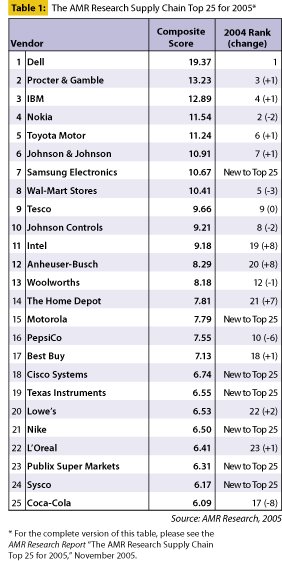 For the second year in a row, Dell tops AMR Research’s Supply Chain Top 25, exemplifying the very best in supply chain practices. The Top 25 identifies the manufacturers and retailers that exhibit superior supply chain capabilities and performance. With superior supply chains comes superior businesses.
Supply chain leaders are able to shape demand, instantly respond to market changes, and crush their competitors. According to AMR Research benchmarking data, leaders carry 15% less inventory, are 60% faster to market, and complete 17% more perfect orders. These advantages separate predators from prey.
http://www.amrresearch.com/Content/View.asp?pmillid=18893

