
Showing posts with label Microsoft. Show all posts
In the recently concluded 2012 Consumer Electronics Show in Las Vegas and National Retail Federation conference in New York, Microsoft demonstrated their vision for Smartstore. The demo included a socially enabled virtual dressing room application called Swivel by FaceCake which is powered by Kinect device. Swivel used Kinect camera to custom fit selected items for the person trying on and overlay them on their body. The demo also includes applications by other partners and shows great use of Microsoft Surface, Windows 7 based tablets and Windows Phone. Here’s a video.
In personal relationships, seven-year itches can be destructive; in the world of information technology, eight-year agreements between a leading software vendor and a global retailer indicates a serious commitment to serious competitive advantage spanning multiple continents.
Tesco signs eight year agreement with Microsoft
Tesco has committed to the Microsoft platform in an eight year, world-wide agreement.
This global deal is aimed to enable Tesco to improve productivity, decision-making, knowledge sharing and operational excellence across the 14 countries in which it currently operates.
The agreement will underpin Tesco’s strategic objectives of growing its international presence; expanding its non-food business; and offering a broad selection of retail services such as banking, online and mobile. Putting innovative technology in the hands of its customers, staff and suppliers will allow Tesco to get closer to its goals of multi-channel retailing and meeting people’s needs as they change.
During the course of this agreement, Tesco and its affiliates will have access to the latest versions of Microsoft products and services in their head offices, stores, distribution and data centres, including Windows, Office, SharePoint, Exchange, Lync, System Center, BizTalk and SQL Server.
Tesco is expecting to see value immediately through the deployment of SharePoint, Exchange and Lync to create a new global collaboration platform. This will allow all employees to find specialist skills and share and access knowledge whenever and wherever they need. Collaboration is seen as enabling the distribution of retail skills and other best practices to its international subsidiaries; facilitating product innovation with internal experts and suppliers; and building communities of expertise.
“We have lots of colleagues in Tesco, doing lots of jobs all over the world,” says Mike McNamara, Group CIO at Tesco. “These technologies can help bring us together to share learning and expertise, views and opinions, thoughts and ideas.”
The deal also includes Microsoft Services’ Enterprise Strategy programme. The Consulting expertise this Programme provides is helping Tesco set strategy and prioritise and deliver projects so risks are minimised and time-to-value is accelerated.
“We are very excited about what this means for both Tesco’s employees and customers as it will change the way Tesco connects internally and with its customers,” says Bill Gonzalez, General Manager, Worldwide Distribution and Services Sector, Microsoft. “Tesco is one of the most innovative global retailers and this commitment confirms their position in the industry as a company that is focused on its customers, as well as driven by forward-thinking leaders.”
The Fall 2011 issue of Speak, Microsoft's customer publication for the retail industry, is out.
Speak, Microsoft's customer publication for the retail industry, provides retail technology and business executives with a digest of the key challenges in the industry, and the technology solutions that can address them. Formerly known as Retailspeak, the magazine includes comment from Microsoft and Microsoft partners and customers in the retail industry.
Retailers are ready to increase their Bing spending
Bing is making inroads into retailers’ search marketing budgets as 41% of merchants plan to divert at least some of their spending from Google Inc. to the two-year-old search engine operated by Microsoft Corp., according to the newest Internet Retailer survey.
By 2015, it's predicted that mobile purchases will total $119 billion globally.
Learn More about 2D Barcodes at Microsoft Tag.

Weis Markets deploys Retalix's Demand-Driven Replenishment solution
by Deepak Sharma on Monday, May 23, 2011

Weis Markets to Reduce Out-of-Stocks, Optimize In-Stock Position With Retalix Solution
"We wanted a system that could provide demand-based forecasting and replenishment and assist us in optimizing our inventory. Retalix's Demand-Driven Replenishment solution was the ideal fit," said Bob Mawyer, vice president of information technology at Weis Markets. "In addition, we expect it to help us drive sales and improve our customer experience by reducing out-of-stocks, while making our operations more efficient and reducing overall costs."
Retalix's Demand-Driven Replenishment solution is part of the Retalix Merchandising Solution Suite. It is a demand forecasting and store replenishment system designed specifically for fast-moving consumer goods retailers, to optimize inventory management and positions, reduce out-of-stocks, streamline the order process, improve cashflow, and help retailers use resources more efficiently.
The Demand-Driven Replenishment solution is based on Microsoft technologies, and is comprised of four core modules: Demand Forecasting, Inventory Management, Order Optimization, and Analytics, and it contains advanced proprietary algorithms to interpret demand and optimize replenishment orders. Retailers using Demand-Driven Replenishment have reported significant out-of-stock reductions, decreased inventory levels and inventory costs, and lower spoilage of perishable products.
Retailers who are thinking of moving to Cloud computing should read the latest whitepaper from Microsoft, Driving Revenue and Innovation in Retail with Windows Azure. The Whitepaper provides solution scenarios along with workload patterns for these scenarios and examples from the industry.
Momentum is building around cloud scenarios applicable to retailing by enabling business agility at lower cost. Microsoft has made a strong commitment to cloud computing to help retailers connect with consumers whenever and wherever they choose. Windows Azure provides a platform and a set of services that can be used individually or together. It is a flexible and interoperable platform that is use to build new applications to run from the cloud or enhance existing applications with cloud-based service-oriented capabilities.
There are business-enabling benefits for retail enterprises, including the ability to extend services related to products and retail offerings directly to consumers. The global reach that can be achieved will enable retailers to deliver products through vastly extended supply chains and product-sourcing approaches. A cloud computing strategy that is integrated with existing business plans will have the effect of reducing cost and increasing services to customers throughout the world.
| Solution Scenario | Workload | Description | Industry |
| Retail Demand Forecasting | On/Off | Sales forecasting, based on raw POS data, delivered as | Lokad |
| Smart Client - Store System | Broad usage | Full store system application which provides a rich user interface and offline capability. Allows retailers to quickly deploy a store system solution with no | Bedin Systems |
| Supply Chain Trading Partner Collaboration | Broad usage | B2B e-commerce collaboration that enables visibility to electronic data interchange (EDI) transactions. This system allows for insight into the trading partner | GXS |
| Consumer Promotions at | Growing fast | Promotional engine built to accept request and deliver email coupon promotions to consumers. | Outback |
| Connecting Stores with | N/A | Microsoft cloud based productivity suite solution to connect distributed users in stores with the enterprise for collaboration features delivered as a service. | McDonald’s |
| Scalable E-Commerce | Predictable | On-premise application augmented with cloud computing for tremendous scale without the cost. | Dominos |
Clinique Smart Bar, great implementation of Microsoft Surface
by Deepak Sharma on Thursday, March 03, 2011
What’s more exciting than innovative technologies? It’s the innovative implementations. Clinique, a manufacturer of skincare, cosmetics, toiletries and fragrances, owned by the Estée Lauder has done just that. Clinique is launching Clinique Smart Bar which is a touch screen counter that is based on Microsoft Surface unit.
Clinique installs Microsoft Surface
The new digital interface enables shoppers to place specially tagged Clinique products on the Clinique Smart Bar. The shoppers can then access product information, and Clinique.com’s best in class user reviews and how-to videos, before adding their products to a virtual browsing basket.
The application allows shoppers to print out a barcode and present it at the nearby express service counter for quick checkout.
Shoppers can also share the virtual browsing basket directly to their Facebook or via e-mail.
“Today’s consumer has more tools and devices than ever before to communicate, connect and learn. From the explosion of smartphones to Google to Facebook, our consumers are looking beyond a one-dimensional experience,” said Ricardo Quintero, Clinique’s senior vice president, global general manager, Market Development.
A picture speaks thousand words so here is how the Clinique Smart Bar looks.

Picture source - Microsoft Surface Blog
Microsoft launches Microsoft Dynamics AX for Retail R2
by Deepak Sharma on Wednesday, March 02, 2011
Microsoft has launched Microsoft Dynamics AX for Retail R2 in Germany at the ongoing Euroshop 2011. The new version of Dynamics AX for Retail includes point-of-sale, store management, supply chain, merchandising and financials capabilities.
This solution, the next iteration of Microsoft Dynamics AX for Retail, offers midsize and enterprise specialty retailers point-of-sale, store management, supply chain, merchandising and financials capabilities to deliver business productivity, enterprise agility and customer service in a single, integrated end-to-end retail solution. It provides visibility from point-of-sale devices to the supply chain and the business insight needed to enable a real-time response to customer demand and build customer loyalty.
Retailers are spending millions of dollars on weekly circulars and its distribution along with Newspapers through mail. Taking this spend online can help Retailers save substantial dollars as well as increase usage/reach using social media features. MSN does exactly that and comes to their rescue with their new Local Deals site. MSN unveiled a new localized deals site through an interactive online circulars experience as part of MSN Local Edition – http://deals.msn.com. So far Kohl’s, Target, Staples and RadioShack have signed up on the site. The circular page features Silverlight and DeepZoom technology, which will provide an immersive consumer experience. The users will be able to:
- Rotate through various circulars all on one screen
- Browse and ‘flip’ through pages just like with traditional circulars
- Search for products across all the circulars at once
- Zoom in on products within a circular at a high resolution
- Hover over to learn more about a specific product, including reviews on Bing shopping
- Add items to a shopping list
- Find retailer locations using Bing Maps
- Share finds with others through social media like Facebook, Twitter, and Windows Live
- Link to a retailer’s site to purchase a product online
The circulars will refresh as often as retailers update information in ShopLocal (who is providing the back-end data for our circular experience) – usually weekly. Circulars that are not current will not be visible, ensuring that consumers are always browsing fresh content. Additionally, since the destination site is geo-targeted, only relevant circulars for a consumer’s location will be shown.

Read More - Microsoft Advertising Unveils Online Circulars for MSN Local Edition (U.S.)
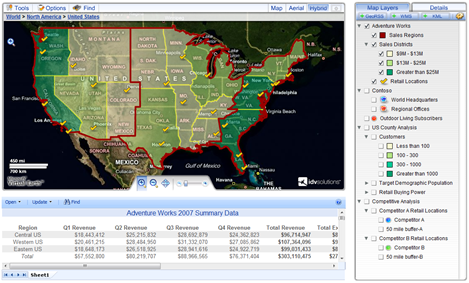
Check out this really cool Retail demo depicting Sales Dashboard on a Map. The color coding on the map and the ability to add details by using layers make it even more interesting. You can drag any asset from the map to the right side details tab and see even more finer details like picture of the store, product revenue etc. The demo utilizes Microsoft SharePoint Server, Virtual Earth and some nifty Flash animation.
The above is a quote from the Video embedded below where Microsoft Industry Solutions Director David Gruehn talks about Innovation and how it impacts retailers.
Not only are retailers dealing with the new economy, they are dealing with an exponentially increasing tech savvy consumer who expects always on, always connected, always right and your next round of employees may be just as demanding of the technology they expect to have access to in your store. Microsoft Industry Solutions Director David Gruehn, and former retail CIO, talks about innovation and how it is impacting retailers.

In the recently conducted Consumer Electronic Show, Microsoft launched Microsoft Tag, real innovative concept to connect mobile barcodes (or tags) on physical objects to online content (opening mobile content, videos, music, contact information, promotions etc). The tag appears as shown below (this one will tag you to my blog, Retail Technology Blog).

From Microsoft Tag website:
Microsoft Tag creates unlimited possibilities for making interactive communications an instant, entertaining part of life. They tranform physical media (print advertising, billboards,product packages, information signs, in-store merchandising, or even video images)—into live links for accessing information and entertainment online.
With the Microsoft Tag application, just aim your camera phone at a Tag and instantly access mobile content, videos, music, contact information, maps, social networks, promotions, and more. Nothing to type, no browsers to launch!
The sophisticated technology powering Microsoft Tag, High Capacity Color Barcodes (HCCBs), was invented by Microsoft Research. It was designed from the ground up for maximum performance with the limited cameras on most mobile phones. Advanced image-processing techniques decode even out-of-focus barcode images, which means Microsoft Tag works with the fixed-focus camera lenses common in most mobile devices.
The advanced computer imaging of HCCBs employs different symbol shapes in geometric patterns and multiple colors to provide more information in less space.
The possibilities are endless for retailers, consider the following scenarios:
-- You go to a store and check out a box of cereals, you see Microsoft tag on the box, you use your Mobile phone Microsoft Tag Reader and you could be shown promotion around the box, you can compare prices with other brand of cereals etc.
-- You go to a store and check out Morningstar Farms Maple Flavored Sausage Patties box and using Microsoft Tag Reader app on your iPhone you are taken to the MSN Chef to the rescue website and are shown Recipes around the product. You are also shown the nutrition information about the product. This will ensure that you buy other ingredients along with the product for the recipe you just decided.
-- You buy a Laptop from Electronics and see a Microsoft Tag on the backside of Laptop. You click it using Microsoft Tag Reader app on your mobile and voila, you just registered your Laptop. You may also be shown the accessories you can buy for your laptop.
These are just few uses I could think on top of my head, there could be 100’s of such scenarios both offline and online. I definitely see Microsoft Tags being targeted by Retailers soon. You can try the app out, here, http://www.microsoft.com/tag/content/download/.
Just came across an Retail Magazine from Microsoft called Retaispeak. The magazine has some very good articles and provides a good view in what other retailers are up to when it comes to Retail Technology.
From restaurants to department stores, retailers face pressure to increase productivity, grow profits and justify every technology investment. Retailspeak, Microsoft’s customer publication for the retail industry, provides retail technology and business executives with a digest of the key challenges in the industry, and the technology solutions that can address them.
Featured topics range from store systems and managing the supply chain through to business intelligence and enterprise collaboration. Retailspeak also provides a round-up of industry news, case studies, commentary, interviews and analysis. In addition to our team of in-house journalists, experts from all areas of the industry provide their insight on the retail industry.
The magazine is published every quarter. Subscribe to Retailspeak to start receiving the definitive word on retail technology.
You can subscribe to the same free at the following URL:
A welcome news for many Retailers, IBM will now offer Windows Embedded for Point of Service as a pre-installed operating system option for its IBM AnyPlace kiosk, SelfCheckout and SurePOS 700, 500 and 300 point-of-sale products. The following analyst view sums it up well.
While unusual, Garf said the deal makes sense for both parties. “For IBM, it gives their hardware prospects and clients more choice for their operating system,” he said. “For Microsoft, given the leadership role IBM plays in hardware, it provides a great channel. Their go-to-market strategy is mostly through channel partners. It’s a win-win.”
Retailers can also benefit from the deal, Garf said. “From a retail perspective, especially when dealing with hundreds or thousands of stores multiplied by the amount of devices in each store, you want simplicity and a hardened technology that won’t break,” he said. “[Windows Embedded-based POS offers] resiliency and simplicity, and being a standards-based technology makes it easier to deploy. From a total cost of ownership standpoint, it makes sense for retailers as well.”
Garf said the partnership demonstrates the open nature of both technologies. “It underlines what both companies have been talking about for a while – standards-based open technology,” he said.
In this post I want to write about Collaborative Logistics. I had proposed a Mashup idea on this topic for which I submitted to Microsoft-BT Mashup competition early last year and I got 1st prize for the same. To borrow the definition of Collaborative Logistics from this article, Collaborative Logistics is achieved when two or more companies form partnerships, or work with existing supply chain partners (customers, suppliers and carriers) to optimize transportation operations by sharing truck capacity to cut the high costs of less-than-truckload shipments and empty back hauls. In my mashup idea, we are talking of SMB's who want to lower the operation costs. The Mashup I have proposed takes into consideration these SMB's need of lowering costs and optimizing inventory. The idea is to share unused capacity in Trucks. Trucks which are not full can communicate the available space to the Mashup Service which will then broadcast the same to Mashup service subscribers using SMS service. Similarly a Truck Owner can broadcast his unused space to subscribers through the Mashup service. The uniqueness of the idea was it targeting the Long Tail of SMB’s.
There is an excellent white paper on Collaborative Logistics by Kevin Lynch who was the CEO of Nistevo which was later acquired by Sterling Commerce. The article while introducing Collaborative Logistics explains how Shippers and Carriers benefit from the collaborative arrangement:
The key to understanding Collaborative Logistics lies in recognizing how costs are distributed in a logistics network. Both shippers and carriers focus a lot of attention on controlling costs to improve profitability. Following a traditional approach, each organization has the ability to increase the efficiencies and reduce the "individual costs" of only those business processes that the organization independently controls. However, they have no visibility over "hidden costs."
Here’s the big question: How is it possible to reduce costs that are hidden? And, here’s the sole answer: Collaborative Logistics. This new business process makes hidden costs visible, so companies can work together to reduce them.
An example of a hidden cost that all members of a logistics transaction pay, but none individually control, is asset repositioning.
• Shipper A requires goods be delivered at a certain place and time.
• Shipper B requires goods be picked up at a certain place and time.
• The carrier must decide how to optimally apply their asset to this situation.
• Shipper A and Shipper B do not understand how their interaction affects asset repositioning costs.
In other words, no single player controls asset repositioning costs. They are a hidden cost paid by all. By maintaining an isolated approach, members of a logistics transaction are limited in their ability to reduce overall costs.
In my mashup which used Web services from Microsoft (MapPoint, Virtual Earth) and BT (Web21C SDK), I have considered two scenarios, Subscriber mode and Publisher mode. So let's take an example of Subscriber mode:
- Contoso Hardware Shop is based in Washington, DC, USA. It needs to send a shipment of heavy duty Spanners to it’s customer in Philadelphia, PA.
- Contoso logs on to Collaborative Logistics Mashup Website using BT Web21C Authentication Service.
- Contoso provides start and end locations of it’s shipment. The start location is filled automatically based on Contoso’s past usage of the service.
- The Collaborative Logistics Mashup service provides a list of truck’s on a Map (using Microsoft MapPoint API or Virtual Earth SDK) which are in the vicinity (near Washington, DC) with their unused capacity. To provide the location of trucks on Map, it uses BT Web21C Location Service.
- Upon selecting a truck on the Map, an SMS (Using Web21C SMS Service) is sent to the Truck with Contoso’s Contact details for them to collaborate and take the process forward. 
Reverse is also possible.
- Litware Truckers, Inc is a Transportation company based out of Philadelphia. It has a fleet of 17 trucks.
-Litware operates its trucks in the north eastern USA. Many times Litware’s trucks travel with unused capacity. These can be used by small businesses which needs to ship small packages and can’t afford full trucks.
-Litware has registered with Collaborative Logistics Mashup website. Truck Drivers can send SMS to Collaborative Logistics Mashup service which is received using Inbound SMS service. The SMS will contain the unused capacity in the truck.
-The Collaborative Logistics Mashup then sends an SMS (using SmsMessage Service) containing Litware truck details including Truck Location (using BT Web21C Location Service) to all registered subscribers. Subscribers have the capability to set their Presence (using BT Web21C Presence service) status to “No SMS” if they don’t wish to get SMS from Mashup service.
-Depending on the location and needs of subscribers, they can contact (call or chat) the Litware Truck for using unused capacity.
Recommended Reading:
Collaborative Logistics: Increasing Supply Chain Management Efficiency

