
Just in time for 2011 Consumer Electronics Show, Sears has launched a new social media initiative called the Sears Blue Blogger Crew. From the Sears blog.
What is the Sears Blue Blogger Crew?
The Sears Blue Blogger Crew is an opportunity for our peers (i.e. fellow gadget geeks) to share their knowledge and experience in the technology space with their readers and followers, as well as our customers. The Sears Blue Blogger Crew is a group of experts who will write about technology, trends and products that we carry here in the Sears Consumer Electronics Department! (NOTE/DISCLOSURE: For CES, Sears Electronics is covering travel costs + expenses for the bloggers in attendance, as well as providing each a small video camera.)
Currently the crew consists of five bloggers, Jenna Hatfield, lead blogger at Stop, Drop and Blog; Kris Cain, lead blogger for LittleTechGirl, Andru Edwards, CEO of Gear Live Media and lead blogger for Gear Live, Kelly Clay, a veteran blogger, works for Lockergnome, Barbara Rozgonyi, founder of the Chicago chapter of the Social Media Club, blogs at WiredPRWorks.
Great initiative as long as these bloggers remain neutral and not become the PR for Sears.
And these two retailers are, Barnes & Noble and Borders. Barnes & Noble today reported strong holiday results led by some good sales of its Nook e-readers. Same-store sales, rose 9.7 percent for the nine-week period ended on January 1. A large part of this increase has come because of the popularity and sales of Nook which is in direct competition with Amazon.com's Kindle e-reader.
Barnes & Noble says Nook boosts holiday sales
Barnes & Noble Inc reported strong preliminary holiday results at its superstores, led by the popularity of its Nook e-readers, and shares rose more than 5 percent.
The top U.S. bookseller said that same-store sales, or sales at its superstores open at least 15 months, rose 9.7 percent for the nine-week period ended on January 1.
Barnes & Noble, which put itself up for sale in August, introduced the Nook in 2009 in a bid to compete with Amazon.com's market-leading Kindle e-reader as it seeks to prove itself viable amid bookbuyers' shift to digital formats.
In the fall, the retailer introduced a well-reviewed, enhanced version of the device, NookColor, which has some functions similar to those of Apple's iPad tablet.
Barnes & Noble in November had forecast same-store sales for the entire current quarter, including the holiday period, would rise between 5 and 7 percent.
Barnes & Noble's numbers include Nook devices sold in stores but not on its website. Last week, Barnes & Noble, which operates 717 namesake stores in the United States, said the Nook had become its best selling single item ever. The retailer said it would release more detailed sales figures on Thursday.
Now compare this with Borders, which is the second largest US bookstore chain after Barnes and Noble. Borders is reporting that it is delaying payments to some publishers trying to avert a liquidity crisis.
Borders Delays Payments to Publishers
In an ominous turn of events for the book business, Borders Group Inc. said Thursday it is delaying payments to some publishers, a sign that its financial troubles are worsening.
The nation's second-largest bookstore chain by revenue, behind Barnes & Noble Inc., said the delays were part of its efforts to refinance its debt and that it had notified the publishers with which it is seeking to restructure payments.
The retailer also said "there can be no assurance" that its larger refinancing efforts will be successful.
Sign of the times, I say. With competition from Kindle and the ebooks, B&N was able to remold themselves as a Digital company with Nook, Borders did not and results are there to be seen. There is more competition coming from Google and that will put even more pressure on Borders to rethink its strategy.
Record $30.8 Billion Online Holiday Season Spending so far
by Deepak Sharma on Wednesday, December 29, 2010
Thanks to some cold weather which makes for some favorable conditions for online shopping (Blizzard in Northeast), holiday season retail online spending is seeing a 13% increase over last year. From comScore release:
comScore a leader in measuring the digital world, today reported holiday season retail e-commerce spending for the first 56 days of the November – December 2010 holiday season. For the holiday season-to-date, $30.81 billion has been spent online, marking a 13-percent increase versus the corresponding days last year. The most recent week (week ending Dec. 26) witnessed $2.45 billion in spending, an increase of 17 percent versus the corresponding week last year.

Retail E-Commerce Spending up 27%, Thanks in part to Free Shipping
by Deepak Sharma on Sunday, December 19, 2010
There’s a 12% increase in retail e-commerce spending in the first first 47 days of the November – December 2010 holiday season compared with the same period a year ago.
comScore is reporting that for the holiday season-to-date, $27.46 billion has been spent online, marking a 12-percent increase versus the corresponding days last year. The most recent week (week ending Dec. 17) reached $5.15 billion in spending, an increase of 14 percent versus the corresponding week last year, with four individual days surpassing $900 million, led by Green Monday (Monday, December 13) with $954 million and Free Shipping Day (Friday, December 17) with $942 million. A lot of shopper took advantage of the Free Shipping Day which achieved a 61-percent increase versus the corresponding shopping day last year, highlighting the appeal and success of the promotion in which more than 1,500 merchants offered free shipping.
| 2010 Holiday Season To Date vs. Corresponding Days* in 2009 Non-Travel (Retail) Spending Excludes Auctions and Large Corporate Purchases Total U.S. – Home/Work/University Locations Source: comScore, Inc. | ||||
| Millions ($) | ||||
| 2009 | 2010 | Percent Change | ||
| November 1 – December 17 | $24,504 | $27,460 | 12% | |
| Thanksgiving Day (Nov. 25) | $318 | $407 | 28% | |
| Black Friday (Nov. 26) | $595 | $648 | 9% | |
| Cyber Monday (Nov. 29) | $887 | $1,028 | 16% | |
| Green Monday (Dec. 13) | $854 | $954 | 12% | |
| Free Shipping Day (Dec. 17) | $586 | $942 | 61% | |
| Week Ending Dec. 17 (Dec. 11-17) | $4,644 | $5,509 | 14% | |
That means Cyber Monday emerged as the season’s heaviest online spending day for the first time in history.
"Free Shipping Day punctuated an exceptional week in which consumers spent more than $5.5 billion online, representing a 14-percent increase from last year," said comScore chairman Gian Fulgoni. "While no individual days during the week surpassed $1 billion in spending, we saw strength throughout the week beginning with Green Monday and ending with Free Shipping Day on Friday. At this late juncture in the online holiday season, we have likely already witnessed the peak spending day of the year, which means that Cyber Monday should emerge as the season's heaviest online spending day for the first time in history."

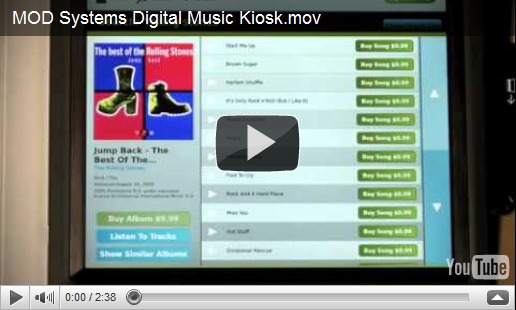
“Retailers are looking for opportunities to capture customer interest in digital entertainment or take back sales that have shifted from their stores to online,” said Anthony Bay, CEO of MOD Systems. “Consumers can now build their digital music collections outside the home without requiring connectivity, while retailers can sell the latest entertainment content in a way that drives impulse purchases and repeat customer visits.”
Check out this Video on how the Digital Music Kiosk works:
Branded retail apps are hot right now—they’re sexy, but they’re also an effective way to connect with customers. A new service from ILoveVelvet, launched today, combines mobile and social media elements in app form, and allows direct engagement for fans of individual retail brands.
Velvet VIP is a branded mobile application that allows retailers to offer e-catalogs, special promotions, personal recommendations and even collection previews. The social media elements enable consumers to provide feedback directly to the retailer and share with friends via Facebook and Twitter. Customers can even pre-order items through the app—meaning that they don’t have to put their names on a waiting list for that hot designer bag.


ILoveVelvet, a leading provider of technology to enhance the retail customer experience, has launched Velvet VIP, a customized retail application designed to reward loyal fans of specific brands. The application, developed for retailers and available to customers enrolled in loyalty programs, provides personalized shopping recommendations based on customer interests and purchases, along with special benefits not available to the general public. The entire system also has built-in options to share reviews via social media.
Velvet VIP, a customer-facing adaptation of ILoveVelvet’s Velvet Suite and Velvet Store software, engages directly with customers on Apple iPads, iPods and iPhones. The retailer controls the interface branding and available content, so that customers have an encounter consistent with the in-store experience. Velvet VIP also offers a social media component, through which customers can push reviews out to Facebook and Twitter and become unofficial brand ambassadors.
Retailers need to leverage every successful opportunity in the coming year, but do they have the visibility to identify them in a timely way?
Distributing timely and accurate information across the retail enterprise to support distinctive business successes is the envy of every retailer. Without the right systems to distribute the data and tools to bring focus to the information, opportunities quickly fade from view. Does your business get the word out and empower field managers, analysts and executives to initiate change?
IBM (NYSE: IBM) today announced that NYC-based apparel manufacturer Bernard Chaus is using SKYPAD delivered analytics through cloud computing to improve sales, analyze in-season buying trends, and track the hottest selling products by store -- down to style, size and color. SKYPAD is enabling Managers at all levels of the organization to make informed decisions based on the timely and accurate receipt of sales data, providing the flexibility to react globally and locally to instant trends.

Bernard Chaus, Inc., a midsize manufacturer and distributor of women's career and casual sportswear, was looking to streamline its sales and merchandising efforts and create a detailed, accurate view of weekly sales trends for their decision makers. With previous manual data collection processes and Excel spreadsheets, there was no guarantee that sales information was correct or all inclusive, compromising the company's ability to react to fluctuations in sales.
Working with IBM and IBM Business Partner SKY I.T. Group, the company developed an analytics-based solution called SkyPAD that provides a weekly report of key business metrics via a web-based dashboard. The dashboard enables improved decision making across product pricing, assortment design, production and distribution. Using the system, Chaus can quickly spot fast selling items, shift products between stores, adjust pricing and make in-season adjustments based on proven consumer demand. Chaus also has the capability to instantly compare profit margins across different retail outlets to identify future brand positioning strategies.
SKYPAD Enables Retailers to:
- Get comprehensive retailer reports faster
- Automate reporting into ONE easy to use platform
- Easily analyze data based on YOUR specific initiatives
- Seamlessly integrate spreadsheets, EDI and portal data into ONE view
- Increase accuracy, productivity and team focus
- Utilize images, scalability and consistency not possible with Excel
A week back an article in NYTimes discussed the math's behind Groupon and the parameters you need to be watchful of to make sense of Groupon.
NYT - Doing the Math on a Groupon Deal
Groupon is advertising. If you don’t need or believe in advertising, there is no reason to look at this. It costs money. Instead of writing a check for an ad, you are choosing to lose money on sales. This can wreak havoc on the brain cells of a good retailer who is always watching profit margins. It can feel wrong, especially when the coupon customers don’t spend more than the amount of the coupon.
Eight key calculations:
1. Your incremental cost of sales — that is, the actual cost percentage for a new customer. If you are giving boat tours and have empty seats, your incremental costs for an additional customer are next to nothing. If you are selling clothes, your incremental costs might be 50 percent of the sale price. Food might be 40 percent. In any case, don’t include fixed costs that you would be incurring any way.
2. The amount of the average sale. If the coupon is for $75, will the customers spend more that that? I have seen more than one retailer complain that nobody spends more than the value of the coupon. That’s unlikely but I am sure it can feel that way, and that is my point: Keep track.
3. Redemption percentage. You don’t really know until the end, but from my experience and from what I have heard, 85 percent is a good guess.
4. Percentage of your coupon users who are already your customers. I’m sure this number varies tremendously depending on the size of your city, how long you have been around, and the type of business.
5. How many coupons does each customer buy? (The more they buy, the fewer people are exposed to your product or service.)
6. What percentage of coupon customers will turn into regular customers? Again, it can seem as if they are all bargain shoppers who will never return without a discount, but that’s almost impossible. Is it possible 90 percent won’t return? Sure.
7. What is the advertising value of having your business promoted to 900,000 people — that’s the number on Groupon’s Chicago list — even if they don’t buy a coupon?
8. How much does it normally cost you to acquire a customer through advertising? Everything is relative.

Consumer Reports notes that the Naughty & Nice Holiday List is not an exhaustive list and that just because the list mention a particular policy doesn’t mean Consumer Reports endorse—or dislike—everything else about that company or the way it does business.
Retailers in the Nice List:
2 L.L.Bean. 100 percent product satisfaction guarantee. Return anything at any time for any reason.
3 Zappos.com. Free shipping and free returns, including prepaid return label.
4 Costco. Open-ended return policy for virtually everything the warehouse retailer sells minus some home electronics, which come with a still-generous 90-day return period.
6 Orvis. For customer service the old-fashioned way, shoppers can call a toll-free number and speak to a human being without wading through an arcane automated menu system. Alternatively, Orvis offers live-chat with support staff, e-mail queries, and a guaranteed response time of two hours or less.
8 J&R. The electronics superstore and e-retailer has a straightforward price-match policy without the many caveats and fine-print exclusions of some other merchants: Find it at a lower price at an authorized seller (the exception being a warehouse membership club) and “we will do everything possible to meet or beat that price” via a special telephone hotline. J&R also gives customers 30 days to ask for a price adjustment on existing orders if they unearth a lower price.
9 Walmart. No receipt, no problem. Customers can return most items to a Walmart store for a cash refund (for purchases under $25), a gift card (for purchases over $25), or even exchange. There’s one catch: More than three such returns within 45 days requires a manager’s approval.
10 Publix. It’s no fun being sick, but if you need an antibiotic, the Florida-based supermarket chain will have its pharmacies dispense up to a 14-day supply for some of the most common generic ones free. All you need is a proper prescription.
Retailers in the Naughty List:
1 Buy.com. No returns for “oversize” TV sets, defined as any model 27 inches or larger. If you fail to inspect set upon delivery and sign shipper’s release, Buy.com says it’s your problem and go deal with the manufacturer. Its website also lacks a phone number for customer contact.
2 CompUSA. For imposing unusually punitive restocking fees of “up to 25 percent” of the purchase price on any product the retailer decides doesn’t meet its return criteria. Nowhere is it spelled out which specific products are subject to such a fee.
3 Best Buy. Offers a 14-day grace period to return computers, monitors, camcorders, and digital cameras.
8 Macy’s. Proving that high shipping fees are not necessarily a thing of the past, the department store chain calculates its freight charges on the dollar amount of the order, not the size and weight of the package. The base fee is $5.95 for orders under $25, to as much as $23.95 for those $300 or more. And that’s standard delivery.
What do you think of these practices?
Signs are that this Black Friday will be a big one for retailers. Hitwise released report today which shows searches around Black Friday are up 31% and the share of visits to Black Friday websites are up 18% last week over the week before Thanksgiving and Black Friday last year.

The top 5 websites captured 81% of all visits to the custom category of Black Friday websites and traffic to Black-Friday.net and BlackFriday.info represented 46% of the total category.
More women than men are visiting the Black Friday websites with visits split 59% female and 41% male and tend to be younger with 59% of visitors under the age of 35. The audience also skews somewhat less affluent, with the highest share of visitors coming from the $30-$59.9k income bracket.
Yesterday comScore had forecasted strong numbers with 11 Percent Growth for 2010 Holiday E-Commerce Spending.

