
New York Times reports:
Google executives said last night that the company planned to move quickly to capitalize on its new Google Base database service, adding a feature that lets merchants provide local shopping information.
Many publishers had become concerned about the potential of Google Base, which could allow the company to dominate the classified advertising business. Now, publishers of services like the Yellow Pages are facing a competitive threat from Google.
Google, based in Mountain View, Calif., said that beginning this morning it would make available a feature that provides a local version of its Froogle shopping service. The service uses a third-party database of national product inventory organized by locality.
Additionally, local merchants will be able to send Google product information that will be searchable from Froogle. For example, if users type "iPod Nano New York," they will see map information with the locations of stores that have the iPod Nano in stock.
...
...
...
Google declined to identify the third-party information service that would provide the initial product inventory information for local stores, but it said there would be data from "several hundred" chains, like Best Buy, Circuit City, Home Depot, Bombay and CompUSA.
The limitation of the service, Google acknowledged, is that the inventory information might not be precise or necessarily up to date.
The service will be freely available to merchants in the United States, Ms. Mayer said. Google, as it frequently notes, plans to gain revenue from the new Froogle service by placing relevant text ads on the same page as the local results.
eC-BP.org has an article on current state of EDI projects.
In recent months, the activity surrounding new implementations of EDI has stagnated. According to Andrew White, Gartner Group's Director of Supply Chain Research, "Generally, traditional EDI is still a sizable business, but there are not a lot of classical EDI projects starting up right now." That being the case, where are all the energy and dollars being spent?
With the emphasis on standardization, and the move toward more Internet based connectivity, the playing field has changed. Add now-ready-for-prime-time Global Data Synchronization to the mix, and suddenly there is an entire new set of issues that need to be addressed. Many companies have recently realized that GDS is a reality and set about to implement it. As they did, the problems became internal rather than external and their efforts have turned to cleaning and standardizing the product data within their own systems.
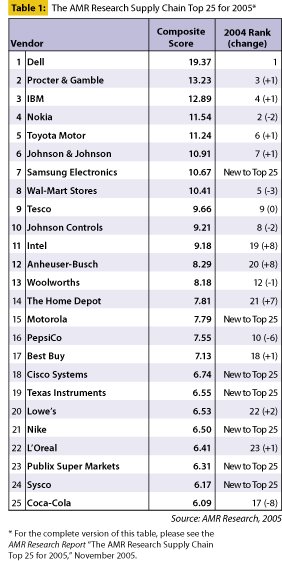 For the second year in a row, Dell tops AMR Research’s Supply Chain Top 25, exemplifying the very best in supply chain practices. The Top 25 identifies the manufacturers and retailers that exhibit superior supply chain capabilities and performance. With superior supply chains comes superior businesses.
Supply chain leaders are able to shape demand, instantly respond to market changes, and crush their competitors. According to AMR Research benchmarking data, leaders carry 15% less inventory, are 60% faster to market, and complete 17% more perfect orders. These advantages separate predators from prey.
http://www.amrresearch.com/Content/View.asp?pmillid=18893
Economic Times reports that Indian Govt is working on according industry status to retail before allowing FDI in the sector.
The commerce & industry ministry is pitching strongly for the this move. In a communique to the PMO, it has said that the “domestic retail industry should be accorded a level-playing field by granting it industry status.” This view is based on a report prepared by the Centre for policy alternatives, which also suggests the government adopt a “gradual” approach towards allowing FDI in retail.
It is felt that resistance to FDI in retail may soften if a level-playing field is provided. It may be easier to convince the Left on this issue. Retailers Big Bazaar, Vishal Mega Mart and Trent will find it easier to strengthen their position once the sector gets industry status.
Some time back Economic Times ran an article on Kishore Biyani. Good Read.
There would be little hyperbole in calling him the father of organised retailing in India. When everyone thought that the concept of hypermarkets (discount stores) in organised retailing was a distant dream in India, he stormed the market with Big Bazaar.
That’s Kishore Biyani for you, the 43-year old chief knowledge officer and managing director of Pantaloon Retail (India), the man who wants to be India’s Sam Walton or to use another analogy the Dhirubhai Ambani of Indian retailing.
Here is another company (other being Oracle) that is on buying spree. After buying Weblogs.com and RSS content feed provider, Moreover Technologies, Verisign has bought Reatils Solutions Inc.
The deal pushes VeriSign squarely into delivering point-of-sale (POS) data, which is gathered at cash registers when customers pay for merchandise at stores, to retailers and consumer-goods and pharmaceutical companies, including Unilever and GlaxoSmithKline, respectively. "Companies want this data so they know exactly what's happening in a store at any given time," said Jeff Richards, vice president of VeriSign’s Intelligent Supply Chain Services business. "But when you provide this information, you're talking about a massive up-tick in the amount of data, billions and billions of records, you need to process." ...
VeriSign now has the tools to build on its infrastructure services in radio frequency identification (RFID) and electronic product code (EPC) technologies in which POS data increasingly is being combined. VeriSign in May shelled-out $15 million for R4 Global Solutions, a consulting-services vendor that assists companies using RFID, electronic product codes, and other data-related supply-chain technologies.
The goal is to combine services from both acquisitions -- tying POS with RFID/EPC data -- to provide real-time visibility and accurate inventory information on products in the supply chain to consumer goods companies, such as Kimberly-Clark Corp. and Gillette Co., which are working on RFID programs with retailers such as Wal-Mart Stores Inc., Target Corp., and Albertson's Inc.
Tying the POS with EPC data embedded in RFID tags on cases and pallets of products will give consumer goods companies visibility into when well-timed promotional items, from razors to shaving cream, and advertising displays are brought from back storerooms at retailers and onto store floors. When the products are sold, the POS data is cross-checked against the RFID/EPC data.
Wal-Mart is trying to fix its negative image with a host of measures that includes media summits, new health care plan for its workers, support to increase the federal minimum wage etc. More here.
Internet Retailer reports on a new survey reporting that while there are fewer returns thanks to customers becoming comfortable and adept at shopping online, the cost of processing returns is high and an average web retailer spends between $6 and $10 for each return.
[Via NRF SmartBrief]
A case study from Microsoft Business Solutions examines the different areas where retailers can implement technology and how it they can use it to improve store operations. (PDF file)

